


A scalable web applications in Pakistan is designed so that it can grow with the business. Instead of rebuilding the entire application whenever traffic or functionality increases, developers can improve or expand individual parts of the system as requirements change.
As businesses move more of their operations online, a basic website is often no longer enough. Ecommerce platforms, SaaS products, marketplaces, customer portals, booking systems, ERP platforms, and other digital products need to handle increasing users, transactions, and data without becoming slow or unreliable.
This is where scalable web applications in Pakistan become important.
For businesses in Pakistan, this is becoming increasingly relevant. DataReportal’s Digital 2026 Pakistan report estimates that the country had around 117 million internet users in October 2025, representing 45.6% of the population.
But scalability does not mean every business needs an expensive cloud infrastructure or a complicated microservices architecture. The right solution depends on the application’s actual requirements.
What Are Scalable Web Applications?
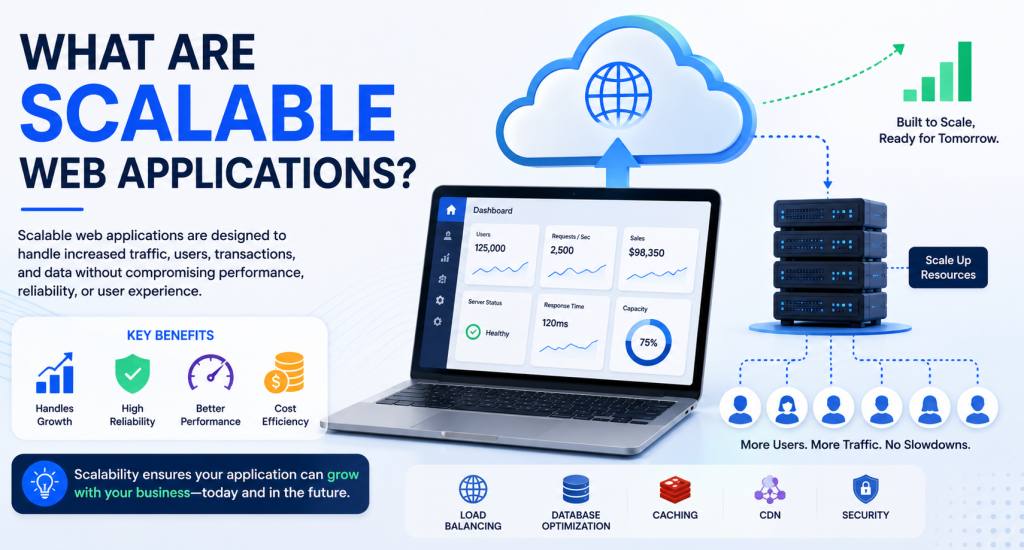
A scalable web application is a web-based software system designed to continue handling increasing workloads without an unacceptable decline in performance, availability, or reliability.
The workload can increase in several ways:
- More users
- More simultaneous users
- More transactions
- More database records
- More API requests
- More uploaded files
- More background processes
- More geographic locations
For example, an ecommerce application might initially serve a few hundred visitors per day. As the business grows, it may eventually need to handle thousands of visitors, product searches, orders, payments, and customer requests.
A scalable architecture allows the application to evolve alongside that growth.
Why Scalability Matters for Pakistani Businesses
Not every website needs advanced scalability.
A small company website containing a few pages of information may work perfectly well on relatively simple hosting.
The situation changes when a business starts operating a platform where users interact with the system continuously.
Examples include:
- Ecommerce marketplaces
- SaaS platforms
- Online booking systems
- Real-estate portals
- Job platforms
- Education platforms
- ERP and CRM systems
- Customer dashboards
- Food delivery platforms
- Financial applications
- Large publishing platforms
A sudden increase in traffic can expose weaknesses that were not visible during normal development.
For example, a website might perform well with 100 visitors but experience database congestion when thousands of users start searching products or submitting requests simultaneously.
That is why scalability should be considered according to expected workload, rather than simply the number of registered users.
What Makes a Web Application Scalable?
Several components contribute to scalability.
1. Application Architecture
The application should be structured so that components can be improved or scaled without unnecessarily affecting the entire system.
A small or medium-sized application may use a well-structured monolithic architecture. Larger applications may eventually benefit from modular or service-based architectures.
2. Database Design
Database performance can become a major bottleneck.
Proper indexing, efficient queries, appropriate data structures, connection pooling, and database monitoring can make a significant difference.
For very large workloads, businesses may eventually consider read replicas, partitioning, or other database scaling techniques.
3. Caching
Frequently requested information does not always need to be retrieved from the database on every request.
Caching can reduce database workload and improve response times.
Redis, for example, is commonly used for application caching, sessions, queues, and other high-speed data operations.
4. Load Balancing
Instead of sending every request to one server, a load balancer can distribute traffic across multiple application servers.
A simplified architecture could look like:
Users → Load Balancer → Server 1 / Server 2 / Server 3
This approach can also make it easier to increase application capacity by adding additional servers.
5. Content Delivery Networks
A CDN can distribute static assets such as images, JavaScript, CSS, and other files closer to users.
This can be especially useful for businesses serving customers in Pakistan as well as international markets such as the UK, Europe, the Middle East, or the United States.
6. Background Processing
Not every task needs to happen while a user is waiting for a webpage to load.
Emails, notifications, reports, image processing, data imports, and similar operations can be handled through background workers and queues.
This allows the main application to respond to users more quickly.
Monolithic vs Microservices Architecture
One of the biggest misconceptions about scalable web applications in Pakistan is that microservices are always better.
They are not.
A well-designed monolithic application can be easier and cheaper to develop, deploy, test, and maintain.
Microservices become useful when there are specific reasons to separate application components.
For example, a large marketplace could eventually separate:
- Authentication
- Product catalogue
- Orders
- Payments
- Notifications
- Search
- Reporting
Each service can potentially be deployed and scaled independently.
However, microservices also introduce additional complexity, including service communication, distributed monitoring, deployment management, network failures, and data consistency.
Therefore, businesses should not choose microservices simply because they sound more advanced.
The architecture should match the application’s actual requirements.
Technologies Used for Scalable Web Applications
There is no single technology that automatically makes an application scalable.
Architecture, database design, infrastructure, code quality, caching, monitoring, and testing are all important.
Common technologies include:
Backend Technologies
- Laravel / PHP
- Node.js
- Python / Django
- .NET
- Java
- Go
Frontend Technologies
- React
- Next.js
- Vue
- Angular
Databases
- PostgreSQL
- MySQL
- Microsoft SQL Server
- MongoDB
- Redis
Infrastructure
- Amazon Web Services
- Microsoft Azure
- Google Cloud
- Docker
- Kubernetes
- CDN and edge infrastructure
- CI/CD systems
The technology stack should be selected according to the application’s requirements, development team’s expertise, budget, and long-term maintenance needs.
How Much Does Scalable Web Application Development Cost in Pakistan?
There is no fixed price for scalable web application development in Pakistan.
A basic custom business application and a large SaaS platform can have completely different development requirements.
The major factors affecting cost include:
- Number of features
- Number of user roles
- UI/UX requirements
- Backend complexity
- Database architecture
- API integrations
- Payment gateway integration
- Third-party services
- Real-time functionality
- Cloud infrastructure
- Security requirements
- Automated testing
- Maintenance and monitoring
For example, an application containing a customer dashboard, payment processing, APIs, reporting, and an administrative panel will naturally require more development work than a simple company website.
Infrastructure is another ongoing cost.
As an application grows, the business may need additional application servers, managed databases, caching, CDN services, backups, monitoring, and other infrastructure.
Therefore, businesses should evaluate total development and operating costs, rather than comparing companies only by their initial development quote.
Companies Building scaleable Web Applications in Pakistan
Pakistan has a growing software and web development industry, with companies ranging from small development teams to large software engineering organizations.
Independent platforms such as Clutch maintain current listings and rankings of web development companies serving Pakistan, based on factors including reviews, experience, services, and market presence. Its August 2026 rankings include companies working across web development, custom software, ecommerce, and enterprise applications.
Below are some companies businesses may consider when looking for web application development services in Pakistan.
1. Xperlet
Xperlet is a Karachi-based web development and digital agency providing web development and digital solutions for businesses.
The company offers WordPress development, Shopify and WooCommerce development, custom integrations, website development, SEO, digital marketing, and other digital services.
Xperlet specifically describes its approach as using flexible technologies to create adaptable and scalable solutions according to individual business requirements.
For businesses looking for a development partner in Pakistan, Xperlet can be considered for projects that need a combination of web development, ecommerce functionality, integrations, and ongoing digital growth.
Website: Xperlet
2. Devsinc
Devsinc is a Pakistan-based software development company with a significant presence in Lahore. It works across web development, ecommerce development, custom software, mobile applications, and other technology services.
Clutch’s current Pakistan listing describes Devsinc as working on custom websites and web applications and highlights its experience across multiple industries.
3. WPExperts
WPExperts is based in Karachi and focuses heavily on WordPress and WooCommerce development, alongside web development, ecommerce development, and custom software services.
Its current Clutch profile lists Karachi as its Pakistan location and highlights custom WordPress and WooCommerce work.
This makes it particularly relevant for businesses whose scalable application requirements are closely connected to WordPress or WooCommerce.
4. PureLogics
PureLogics operates from Lahore and provides full-stack web development, custom software development, mobile applications, and other technology services.
Clutch’s current profile describes the company as working on custom websites and web applications and highlights its technical and project-management capabilities.
5. Ebryx Tech
Ebryx Tech is a Lahore-based technology company offering web development, custom software development, application testing, cybersecurity, and other services.
Its current Clutch profile specifically identifies custom web application development as part of its service offering.
6. CarbonTeq
CarbonTeq is another Lahore-based company providing full-stack web development and custom web application development.
Its current Clutch listing identifies web development and custom application development among its services.
7. WeUno Technologies
WeUno Technologies is based in Karachi and provides web development, mobile application development, custom software development, and other technology services.
Its Clutch profile currently lists web application and full-stack development among its capabilities.
How Should You Choose a Company?
The biggest mistake is choosing a development company simply because it claims to build “scalable applications.”
Instead, ask the development team practical questions.
Architecture
What architecture would you recommend for the application, and why?
Database
How will the database handle increasing users and transactions?
Performance
How will you identify and fix performance bottlenecks?
Infrastructure
Can the application scale horizontally if traffic increases?
Security
How will authentication, authorization, API security, backups, and sensitive data be handled?
Testing
Will the application undergo load and performance testing?
Monitoring
How will the team know when the application starts experiencing performance problems?
Future Development
Can new features be added without rebuilding the entire application?
The answers to these questions are often more valuable than a long list of programming languages.
Common Mistakes When Building Scalable Applications in pakistan
Building for Millions of Users From Day One
A startup does not necessarily need infrastructure designed for millions of simultaneous users.
Overengineering can increase development and infrastructure costs unnecessarily.
Ignoring Database Performance
An expensive server cannot compensate indefinitely for inefficient database queries or poor database design.
Adding Microservices Too Early
Microservices can solve real problems, but they can also create unnecessary complexity for smaller applications.
Not Monitoring the Application
Without monitoring, businesses may only discover performance problems after customers start experiencing them.
Treating Security as an Afterthought
As the number of users and integrations increases, security becomes increasingly important.
Forgetting Infrastructure Costs
Development is only one part of the cost.
Cloud hosting, databases, backups, CDN, monitoring, email services, storage, and third-party APIs can all contribute to ongoing operational expenses.
How to Prepare a Web Application for Growth
A practical approach is to build the first version around current requirements while keeping future expansion in mind.
For example:
Stage 1
Application server + database
↓
Stage 2
Application server + optimized database + caching
↓
Stage 3
Load balancer + multiple application servers + caching
↓
Stage 4
Database scaling + background workers + CDN + monitoring
↓
Stage 5
Additional services or microservices where the workload actually requires them
The important principle is to scale based on measured bottlenecks, not assumptions.
Final Thoughts
Scalable web applications in Pakistan are becoming increasingly relevant as businesses move beyond simple websites and build ecommerce platforms, SaaS products, marketplaces, customer portals, and business management systems.
However, scalability does not mean using the most complicated architecture available.
A successful application should be designed around its expected workload, business requirements, security needs, budget, and future growth.
For some businesses, a well-structured monolithic application will be sufficient. Others may eventually require multiple application servers, load balancing, caching, queues, database replicas, CDNs, and more advanced architectures.
The best approach is to start with a solid architecture, measure real-world performance, identify bottlenecks, and scale the components that actually need scaling.
For businesses searching for scalable web application development in Pakistan, companies such as Xperlet, Devsinc, WPExperts, PureLogics, Ebryx Tech, CarbonTeq, and WeUno Technologies represent different options depending on the project’s requirements and technical complexity. Current third-party listings such as Clutch can also be useful when comparing portfolios, reviews, service focus, and company experience.