


Pakistan’s e-commerce market is entering a more mature phase in 2026. What started largely with marketplace selling, social-media pages and Cash on Delivery is gradually moving toward something more structured: independent online stores that businesses own and control themselves.
One of the clearest signs of this shift is the growing presence of Shopify stores in Pakistan.
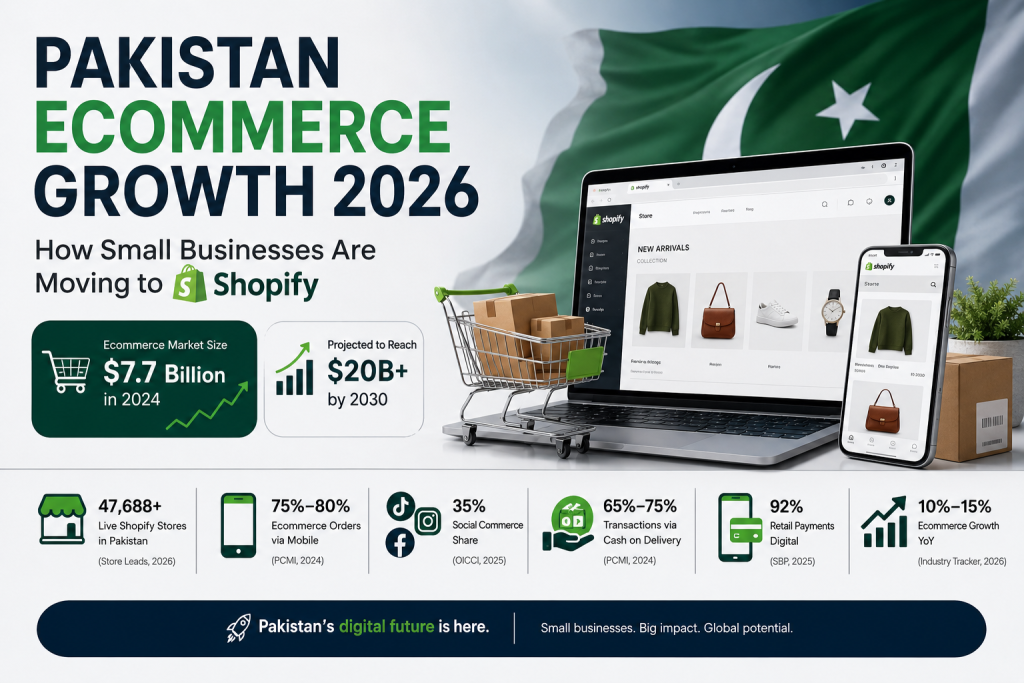
The latest Store Leads data identifies 47,688 live Shopify stores associated with Pakistan, while its tracking shows Shopify stores in the country grew 14.4% quarter-over-quarter in Q2 2026 and 9% year-over-year.
At the same time, Pakistan’s broader e-commerce ecosystem continues to expand. OICCI’s latest digital report puts Pakistan’s 2024 total e-commerce sales at $7.7 billion, including approximately $5.4 billion in retail e-commerce, and projects the broader market to reach around $12 billion by 2027.
The important story, however, is not simply how large Pakistan’s e-commerce market has become.
It is who is building the next generation of online businesses — and why so many smaller businesses are moving toward Shopify.
Pakistan’s E-commerce Market Is Growing — But the Numbers Need Context
Different research providers use different definitions when measuring Pakistan’s e-commerce market.
For example, PCMI estimates that Pakistan’s total e-commerce volume reached $7.7 billion in 2024, while retail e-commerce accounted for approximately $5.4 billion. PCMI projects a 17% CAGR through 2027, taking total e-commerce volume toward approximately $12 billion.
OICCI’s 2025 digital report provides a similar picture, reporting $7.7 billion in 2024 e-commerce sales and a projected $12 billion market by 2027.
This distinction matters.
A report discussing the entire digital commerce ecosystem may include categories and transactions that are not directly comparable with a report measuring only physical B2C retail purchases.
Therefore, rather than relying on one headline number, the broader trend is more useful:
Pakistan’s online retail economy is expanding, smartphone-driven shopping is becoming mainstream, and more businesses are investing in their own digital storefronts.
From Social Media Selling to Independent Online Stores
For many Pakistani entrepreneurs, the first step into e-commerce was not a website.
It was Facebook.
Then Instagram, WhatsApp, TikTok and marketplaces such as Daraz became important sales channels.
This model allowed small businesses to start selling without investing heavily in technology. A clothing seller could post products on Instagram, receive orders through WhatsApp and send them through a courier using Cash on Delivery.
But as businesses grow, this model starts creating limitations.
A business operating entirely through social media does not have complete control over its storefront, customer journey or customer data. Marketplace sellers also have to operate within the rules, fees and algorithms of the platform they depend on.
This is where independent e-commerce websites become increasingly attractive.
Instead of simply asking:
“Where can I sell my products?”
business owners are increasingly asking:
“How can I build an online store that I actually own?”
That change in mindset is one of the biggest developments in Pakistan’s e-commerce market.
Why Shopify Is Becoming Popular Among Pakistani Businesses
Shopify’s growth in Pakistan provides an important indicator of this transition.
According to Store Leads, Pakistan had 47,688 live Shopify stores in its latest August 2026 database update. Its historical tracking shows Shopify’s Pakistani store footprint rising from just 945 stores in Q1 2019 to more than 47,000 identified live stores in its latest tracking.
The growth has not been perfectly linear, but the overall direction is clear.
For small and medium-sized businesses, Shopify offers something that social media pages and marketplaces cannot easily provide:
1. A dedicated brand experience
Businesses can create a storefront around their own brand rather than fitting their products into a marketplace environment.
This matters particularly for fashion, beauty, accessories, pet products and lifestyle brands where visual presentation strongly influences purchasing decisions.
2. Greater control over the customer journey
A dedicated Shopify store allows a business to control its:
- Homepage
- Product pages
- Collections
- Checkout experience
- Promotions
- Upselling
- Email capture
- Analytics
- Retargeting
- Customer communication
The website becomes more than a product catalogue.
It becomes the company’s digital storefront.
3. Integration with marketing channels
Modern e-commerce businesses rarely depend on a single traffic source.
A Shopify store can become the central destination for customers coming from Google, Facebook, Instagram, TikTok, WhatsApp, email marketing and paid advertising.
This is particularly important as social commerce continues to expand in Pakistan.
OICCI’s digital report estimates that social commerce through platforms such as Facebook, Instagram, TikTok and WhatsApp could account for around 35% of online retail by 2026.
Social media can therefore generate demand while the Shopify store handles the actual branded shopping experience.
Mobile Is Driving Pakistan’s E-commerce Growth
Pakistan is increasingly a mobile-first e-commerce market.
PCMI reports that approximately 80% of Pakistan’s e-commerce volume in 2024 came from mobile devices, compared with 20% from desktop.
OICCI similarly reports that more than 80% of users primarily use mobile devices for e-commerce purchases.
For small businesses, this changes what a successful online store needs to look like.
A website cannot simply be designed for a desktop screen and then made responsive afterward.
The mobile experience needs to be considered from the beginning:
- Fast-loading product pages
- Clear product images
- Simple navigation
- Easy checkout
- Large touch-friendly buttons
- WhatsApp integration
- Multiple payment options
- Clear delivery information
- Trust signals and reviews
For many Pakistani shoppers, the smartphone is the storefront.
Cash on Delivery Still Defines Pakistani E-commerce
Pakistan’s e-commerce growth does not mean the country has suddenly become a completely cashless market.
Cash on Delivery remains one of the defining characteristics of online shopping.
PCMI estimates that COD represented approximately 75% of Pakistan’s e-commerce payment volume in 2024. Debit cards accounted for 9%, credit cards 8%, digital wallets 4%, bank transfers 2%, and BNPL approximately 1%.
This creates a unique challenge for Pakistani online stores.
A merchant may successfully generate an order online, but the transaction is not truly completed until the customer receives the parcel and pays.
That introduces additional risks:
- Fake orders
- Unreachable customers
- Order cancellations
- Refusals at delivery
- Incorrect addresses
- Return-to-origin costs
- Cash-flow delays
As a result, successful Shopify stores in Pakistan often require more than attractive design.
They need local e-commerce infrastructure.
That can include WhatsApp order confirmation, COD verification, courier integrations, automated notifications, analytics and payment integrations suited to Pakistani customers.
Digital Payments Are Growing at the Same Time
Although COD remains dominant in e-commerce, Pakistan’s broader payment infrastructure is rapidly becoming more digital.
The State Bank of Pakistan’s Q2 FY2025-26 Payment Systems Review reported 3.4 billion retail payment transactions during October–December 2025, with 92% conducted through digital payment channels. The report also recorded 305.1 million e-commerce transactions worth PKR 422 billion during the quarter.
Raast is also becoming increasingly important to Pakistan’s digital payment infrastructure. The same SBP report recorded 2.1 million merchants registered on Raast P2M and 48.3 million Raast P2P IDs.
This creates an interesting situation:
Pakistan’s general payment infrastructure is digitizing faster than e-commerce’s payment behavior.
In other words, consumers are becoming increasingly comfortable with digital financial services, while many online shoppers still prefer COD when purchasing physical products.
That gap could become one of the biggest opportunities for e-commerce businesses over the next several years.
Why Small Businesses Are Moving Away From Marketplace-Only Selling
Marketplaces were essential in helping Pakistani businesses enter e-commerce.
But once a business develops its own brand and customer base, the economics of marketplace dependence can become less attractive.
Businesses may want:
- More control over branding
- Greater ownership of customer relationships
- Direct access to analytics
- Better remarketing opportunities
- Flexible promotions
- Custom product pages
- Subscription and loyalty features
- Better integration with advertising platforms
- A more professional appearance
This does not mean marketplaces are disappearing.
In fact, a strong e-commerce strategy can use both.
A business can sell through marketplaces to access marketplace traffic while simultaneously building its own Shopify store as its long-term brand asset.
The difference is that the marketplace becomes a sales channel rather than the entire business.
What Xperlet’s Project Experience Shows
Our own project experience provides another perspective on this transition.
At Xperlet, we completed:
- 5 Shopify projects in 2024
- 10 Shopify projects in 2025
- 20 Shopify projects in 2026 so far
That represents a significant increase in the number of Shopify projects handled over this period.
The businesses we have worked with include clothing brands, pet stores and leather-product businesses.
One common requirement has repeatedly appeared across these projects:
business owners want their online store to look professional.
Many of these businesses were already selling through Instagram, WhatsApp or marketplaces before moving toward a dedicated Shopify store.
This is important because it demonstrates a common path for Pakistani small businesses:
Social media → marketplace selling → branded e-commerce website → multi-channel e-commerce.
The website is not necessarily replacing Instagram, WhatsApp or marketplaces.
Instead, it becomes the central platform connecting them.
The New Pakistani E-commerce Business Model
The emerging model looks something like this:
TikTok / Instagram / Facebook
↓
Advertising + Organic Content
↓
Shopify Store
↓
COD + Digital Payments
↓
Courier / Logistics
↓
WhatsApp & Email Retention
↓
Repeat Customers
This is very different from the early e-commerce model where a seller simply uploaded products to a marketplace and waited for orders.
Today’s successful small e-commerce business increasingly needs to think about the entire customer lifecycle.
Clothing Remains One of the Biggest Opportunities
Fashion and apparel continue to play a major role in Pakistan’s online retail ecosystem.
OICCI’s digital report places fashion and apparel at approximately 28% of the e-commerce sector, ahead of electronics and gadgets at 22% and grocery and essentials at 18%.
This helps explain why Shopify adoption is particularly visible among clothing and lifestyle brands.
Fashion brands benefit from:
- Strong visual branding
- Social media marketing
- Influencer campaigns
- Product photography
- Collections
- Seasonal campaigns
- Retargeting
- Repeat purchases
A dedicated Shopify store gives these businesses significantly more control over how their products are presented compared with a generic marketplace listing.
The Challenge: Logistics and Customer Trust
Pakistan’s e-commerce opportunity comes with significant operational challenges.
COD creates additional delivery and return risks, while customers may hesitate to pay online because of concerns about scams, counterfeit products or poor-quality goods.
That makes trust one of the most important assets for a new online store.
A professional e-commerce website should therefore provide:
- Clear product information
- Real product photography
- Customer reviews
- Contact information
- Return and refund policies
- Delivery information
- Secure payment options
- Social proof
- WhatsApp support
- A professional brand identity
For a small business, these elements are not merely design features.
They are conversion infrastructure.
Pakistan’s E-commerce Policy Could Accelerate the Next Phase
The Government of Pakistan’s draft e-Commerce Policy 2.0 (2025–30) identifies areas including digital payments, logistics, consumer protection, SME digitization and cross-border e-commerce as important parts of the country’s future digital trade ecosystem.
This is particularly relevant to small businesses.
If payment systems improve, addressing and logistics become more reliable, consumer protection becomes stronger and cross-border selling becomes easier, the cost of running an online business can decline.
That could encourage thousands of traditional businesses to move further into digital commerce.
The Ministry of Commerce continues to list e-commerce policy among its trade-policy initiatives, making government policy an important factor to watch as Pakistan’s digital economy develops.
What Could Pakistan’s E-commerce Market Look Like by 2030?
The next stage of Pakistan’s e-commerce growth is unlikely to be driven only by more people buying products online.
It will increasingly be driven by better digital businesses.
The winners are likely to be businesses that combine:
Strong products + professional branding + mobile-first websites + social media + digital payments + reliable logistics + customer retention.
The shift toward Shopify is part of this broader transition.
A Shopify store does not automatically make a business successful.
But for a growing brand, it can provide the infrastructure needed to build an independent digital presence instead of relying entirely on third-party platforms.
What Small Businesses Should Do in 2026
For a Pakistani business currently selling through Instagram, WhatsApp or Daraz, the decision does not have to be either/or.
A practical strategy can be:
Stage 1: Establish demand
Start selling through social media and marketplaces.
Stage 2: Build the brand
Develop consistent branding, product photography and content.
Stage 3: Launch an independent store
Build a professional Shopify website and connect the existing sales channels.
Stage 4: Build customer data
Collect customer information responsibly through purchases, email subscriptions and marketing consent.
Stage 5: Improve conversion
Optimize product pages, checkout, mobile performance, reviews and trust signals.
Stage 6: Reduce dependence on any single channel
Use Google, Meta, TikTok, email, WhatsApp, organic search and marketplaces to diversify customer acquisition.
This approach allows small businesses to benefit from existing platforms while gradually building an asset they control.
The Bottom Line
Pakistan’s e-commerce story in 2026 is no longer simply about whether people are buying online.
They are.
The bigger question is how Pakistani businesses are adapting to that behavior.
The data shows a growing e-commerce market, mobile-first purchasing behavior, continued dominance of COD, rapid digital-payment infrastructure growth and a substantial Shopify ecosystem.
And the experience of small businesses tells an equally important story.
Many entrepreneurs start with Instagram, WhatsApp or marketplaces because these channels are easy to enter.
But as their businesses mature, they increasingly need something they can control.
That is where Shopify fits into Pakistan’s e-commerce growth story.
The next generation of Pakistani online businesses may not be marketplace businesses at all. They may be independent brands using marketplaces and social media as acquisition channels while their own websites become the centre of the business.
For Pakistan’s small businesses, 2026 could therefore represent a major transition:
from selling online to building an online business.
Sources & Data Notes
- Pakistan e-commerce market size, retail volume, mobile commerce and sector composition: OICCI Digital Report 2025.
- Pakistan e-commerce market, payment-method distribution, mobile commerce and 2027 projection: PCMI.
- Shopify store count and growth in Pakistan: Store Leads, updated August 21, 2026.
- Digital payments, e-commerce transactions and Raast merchant/payment data: State Bank of Pakistan, Q2 FY2025-26 Payment Systems Review.
- Pakistan e-Commerce Policy 2.0 (2025–30): Ministry of Commerce, Government of Pakistan.